

Selling your home is a big deal. Learn how to sell your house and navigate the process, from setting a price to closing the deal.
You love and cherish your home. You want the next owner to fall in love with it, too — through photos, through words, and through the experience of walking through your front door. But, perhaps most, you want to get the price you want.
This isn’t a small task. Selling a home requires work. It requires time. The journey isn’t always easy. There will be frustrations. But when you seal the deal and move on to your next chapter — wow, what a blissful feeling.
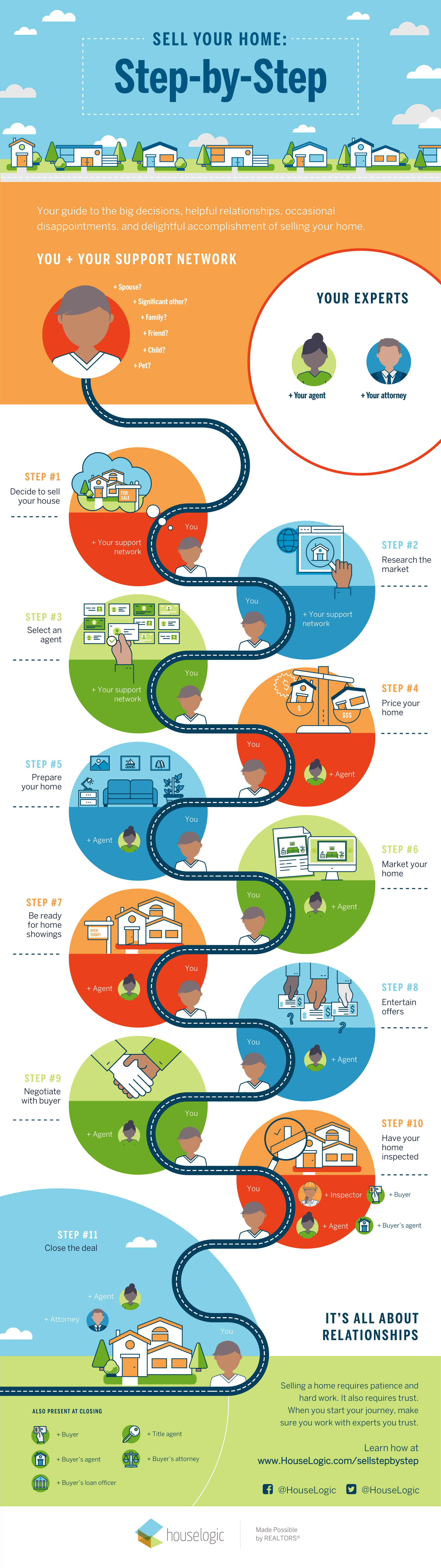
The infographic below previews each step in your journey. Then, read on to learn about the whole process. This article describes how to know what you want (and what your partner wants, if you’re selling together). How to understand the market, and ways to make a plan. And most importantly, how to create relationships with experts and trust them to help you get the job done.
Know Exactly What You Want
First things first: You need to know what you want (and what your partner wants) in order to sell your home with minimum frustration. Why are you moving? What do you expect from the process? When, exactly, should you put that “For Sale” sign in the yard? We can help you get your thoughts in order with this home selling worksheet.
Do Your Research
Unless you bought your home last week, the housing market changed since you became a homeowner. Mortgage rates fluctuate, inventory shifts over time — these are just a few of the factors that affect the state of the market, and every market is unique. Educate yourself on what to expect.
Luckily, you have a few resources at your disposal to figure out where your house stands among the crowd: a listing agent’s expertise and guidance, plus online property sites to get insight into the market.
So take a deep breath. Then do your homework. The more you know, the more confident you’ll be when it’s time to make those big decisions.
Interview and Select an Agent
Yes, you need an agent. This is the most important relationship you’ll form in your home selling journey. A listing agent has your back when it comes to the financials like setting a listing price, as well as marketing, staging and making repairs to your house. He or she can also help you navigate more personal issues, such as your timeline, and what you’re hoping to achieve with the sale.
Pick the right agent and you’ll likely get a better sales price for your house.
Before you start interviewing prospective agents, have a clear sense of what you want to get out of the selling process. When so much money is on the table, it’s crucial to know what your goals are, so that you can find an agent who really speaks to them.
Then, it helps to understand what a listing agent does. The listing agent will:
- Work with you to price your home
- Market your home (we’re talking pretty pictures, social media promo, cute staging — the works)
- Negotiate with home buyers
- Usher the home sale through inspection and closing
Ask these questions to help assess whether an agent is the right fit you:
- Do you work as an agent full-time? Like most professions, much of real estate is learned on the job.
- How long have you been in the business? Generally, the more experience an agent has, the more they’re tapped into the local market.
- How many homes have you sold in my neighborhood in the past year? You don’t need to find an agent who specializes only in your community, though that would be ideal. You do want someone who has recently sold at least a few homes in your neighborhood and knows the local and hyper-local inventory.
- What’s the typical price range of homes you sell? Most agents work across multiple price points, but you don’t want an agent who has never sold a home in your range.
- What’s your fee? An agent should be able to articulate their value and explain their commission rate.
- How will you market my home? You don’t want to hire someone who’s just going to stick a For Sale sign in your yard and call it a day. The agent should present a comprehensive marketing plan for your listing — this should include strategies for staging your home, taking professional photographs of your home, promoting the listing, marketing to other brokers, scheduling open houses, etc.
- Will I be working with you directly, or with a team? Some agents work as part of a sales team. The lead listing agent shares client responsibilities with other agents. Where one agent may handle private showings for a listing, another may host open houses. The most successful teams also have dedicated customer care and marketing professionals. A benefit is that for the same fee, you get many people working for you.
- Will you provide one-on-one service? Whether you’re working with one agent or a team, ask how responsive they can be to you, your timeline, and your goals.
- How long on average are your listings on market? Your average sold-to-list price? This can help you determine whether the agent is a solid marketer and negotiator. These are real estate stats that the agent can pull from your local multiple listing service, or MLS.
The bottom-line: It’s in your best interest to pick an agent who understands your goals, fits your personality, and can get your home sold for top dollar. When you meet someone who can offer all of the above, congratulations — you’ve found your listing agent.
Price Your Home to Sell
Buyers think of value, but they’re more concerned with price. And your home’s price is one of its most attractive — or unattractive — features. The right price can attract buyers, quickly. The wrong price may mean the house sits on the market, which can create the vibe among buyers that there’s something wrong with it.
Go ahead and look at those sites that give home value estimates for a general idea on pricing when deciding how to sell your house. But seller beware. There are a lot of factors specific to your home that an algorithm won’t pick up on, but your human real estate agent will.
An agent has access to data you don’t. They can do a comparative market analysis that checks the price of houses similar to yours that have sold in the past 90 days. It’s like taking the pulse of the market within a couple of miles of your house.
The agent will give you a market value for your house, and then it’s up to you, with your agent’s guidance, to set the price. And the price needs to be right.
Prepare Your Home for Sale
Time to get your house looking its best. When selling your home, you want to make it look like someone else’s dream home. Today’s homebuyers have unlimited access to property listings online. So, you have to make a great first impression — online. That means you have to declutter all the stuff you’ve accumulated over the years, make any necessar repairs, and get your home in swoon-worthy condition.
Repair everything you know of that’s broken. Fix the little things, like the toilet that runs, the closet doors that don’t shut all the way, the hole in the fence. Fix the big things, too, like a leaky roof or a malfunctioning HVAC. Home buyers may not notice the windows are sticking and the wiring is outdated, but an inspector will. Head off problems now. Get a pro out to check any major systems you suspect could have an issue.
Clean up as if company was coming. Hire a cleaning service to do a deep clean — the kind where they scrub the baseboards and toekicks and vacuum behind the refrigerator. Power wash the house and driveway. Make sure your landscape is spiffy, too: boxwoods trimmed, lawn mowed, flower beds weeded. Curb appeal matters.
Declutter. Tidying up is the way to sell your house. You need to bust the clutter and make your house look Insta-perfect. Clear the kitchen counters, pack up most of your books and all of your knickknacks and take them to a storage unit or donate them to charity. Cull your clothes and donate the ones you haven’t worn in more than a year. Clean out the garage, tidy up the laundry room, organize the pantry. All this tidiness and organization signal to potential buyers that your house has been well cared for — and has plenty of room for all their clutter.
Depersonalize your space. Take you out of your home. Box up family photos, your great-grandma’s heirloom quilt, your son’s Matchbox car collection. It sounds sad, but it’s how to sell your house. You want buyers to be able to see themselves and their things in the house. They can’t do that if it feels like your house. Look at this as the first step in packing up to leave. Consider renting a storage unit for the stuff until you move.
Stage your house. This is one step beyond the decluttering, depersonalizing and cleaning. This is when you set up your house to show off its assets and downplay its weaknesses. It usually means moving furniture and making your house look as perfect as a photo in a shiny décor magazine. Staged houses can sell faster and at a higher price. Staging a home is key if you’ve moved out and the house is empty. A professional stager will bring in décor and make your house look as if it’s lived in by the tidiest, most tasteful minimalists in the world.
Paint the interior of your house, especially walls that are an unusual color. You adore the Yves Klein blue in the bonus room. Buyers might not. This isn’t a criticism of your taste. It’s just part of depersonalizing your house, all part of how to sell a house. Pick a nice, neutral tone, like gray or beige.
Paint the outside of your house, too, if there’s any flaking or worn paint, or if you painted the exterior an unconventional shade that might turn off buyers.
Market Your Home
Home buyers look at countless listings online. The best-marketed homes have beautiful photos, professional videos and compelling property descriptions, so they can get “liked” and “saved” on listing sites — which adds to buyer interest. Major brands, like Sotheby’s International Realty, provide powerful marketing support to agents and their clients.
Your real estate agent will handle the marketing of your home, but here’s what you need to know:
Photos and Video. This seems a no-brainer in a digital world, but plenty of sellers forget to prioritize the quality of their photography and video. Make sure photos are well-lit, in focus, and high resolution so they don’t pixelate on tablets and smartphones. Your agent may very well offer a professional photographer as part of his or her services to you. If not, consider hiring a professional photographer, especially if you’re in a high-end home. Some agents have special access to put professional video in Zillow’s video slot.
Virtual tours are becoming the norm. Buyers swoon over them, because a virtual tour takes them by the hand and leads them through the house. You’ll need to hire an outside company to create one. Your agent should be able to connect you with a business who does virtual tours. Again, some agents offer this as part of their listing services.
Signage — like the classic For Sale sign — are basics for selling your home. There should be a sign in your front yard, with your agent’s contact info on it. Especially during open houses, you should expect signs on busy streets nearby with an arrow pointing the way to your house. If you’re deep in a winding subdivision, you may need more signs directing folks to your house. If your home is part of a homeowners association, be sure to see if the HOA is OK with agent signs.
Social media. Your agent will likely post your listing to various social channels. And put your listing on your social channels, too.
Word of mouth is old-fashioned, but works. Tell your friends, acquaintances, and co-workers your house is for sale.
Property listing sites will pick up your house listing once your agent puts it on the MLS (Multiple Listing Service.) There’s a gaggle of them, from individual agency sites to biggies like realtor.com and Zillow.
Showcase Your Home
One of the best ways to get buyers in the door is to have an open house. This is your chance to show off your home’s best assets, and help buyers envision themselves living there. Know how your agent will organize, advertise and host the event to ensure it is a success.
Another way to showcase your home is for your agent to provide private, personal showings to prospective buyers and their agents. This is especially true for high-end homes. No other agent knows the ins and outs of your home like your agent.
Here’s how to pull off a good open house and showing:
Clean again. You decluttered, depersonalized, fixed, and fussed over the place when you listed it. Take another pass, especially if you’ve been living in the house. Hire a housecleaning service to give it the once-over.
Make special preparations, like moving the cars out of the driveway and away from your house so the open house attendees focus on your house and have a place to park. Open the blinds and drapes to let in the light and turn on the interior lights.
Make sure your house smells fresh, but go easy on air fresheners. Some people are allergic to them, and heavy use of them may make shoppers wonder what smell you’re trying to hide.
Send pets away. Let them go on a playdate with a pal, or board them for a few hours. You don’t want them distracting visitors from the house. Hide their toys, bowls, and beds, too, to stave off smells.
Vacate the house. Prospective buyers will be more open in terms of feedback if you’re not in attendance. Let your agent handle it.
Receive Offers
The day will come — and it will be a wonderful, joyous, do-a-happy-dance day — when you receive an offer, or multiple offers, for your home. And on that day, you’re going to face a question you may not have previously considered: How do you know if an offer is the best one for you?
Your listing agent will be a big help here. They will understand and help you suss out the merits and faults of an offer because — believe it or not — it’s not always about price. One buyer’s beautifully high offer might not look so good anymore, for example, if you discover that it’s contingent upon you moving out a month earlier than planned. Or, conversely, you may prefer speed over price, particularly if you’re moving to a new city.
Your listing agent will have a sense of what you want financially and personally — and can help you determine whether the offer at hand satisfies those goals.
An offer will specify a price, the down payment amount, the deposit amount, the terms, the date you’ll have to move out, and any contingencies. When you get an offer, you have three options:
- You can accept it as is.
- You can reject it.
- You can reject it and counter it with an offer of your own.
Negotiate with the Buyer
To get the best deal, you’ll likely have to do some negotiating. Unless you’re being offered an amount equal to or above the full listing price, many buyers expect you to make a counteroffer — which is why a lot of people make an initial offer that’s lower than the asking price, and why a lot of buyers make an initial offer that’s lower than what they’re ultimately willing to pay.
Counteroffers usually hinge on four things:
- Price
- Terms
- Occupancy (when you move out, and buyers move in)
- Contingencies (special conditions)
Note, it’s rare to reject an offer with no counteroffer. That kills the deal, and it’s not how to sell your home. Counteroffers are the most common outcome. Your agent will help you craft the counteroffer and then negotiate with the prospective buyers.
So, sit down with your agent and have an open discussion about your goals. Do you want more money? A faster closing period? Fewer contingencies? When you review these types of questions with your agent before you respond to an offer, and have a crystal-clear sense of your priorities, the negotiation process will go a lot more smoothly.
A deal is under contract when the buyer’s offer (or seller’s counteroffer) is agreed upon and signed by both parties. At that point, the clock starts ticking for the home buyer’s contingencies — and for the sweet moment when the cash — and home — is yours.
Contract to Closing
Settlement, or closing, is the last step if the home selling process. This is when you sign the final paperwork, make the transaction official, and collect your check. Before that can happen though, you’ll have to navigate all the terms of the contract — the buyer’s inspection, negotiating any repair requests that may arise from the inspection, and making sure that all contingencies are met on time. A good agent will have a detailed contract-to-closing checklist and will walk you through the entire process.
Inspection. This is when a buyer’s housing inspector examines the house to look for problems, like windows that stick, wiring that’s not up to code, or mold. When they find a problem, the buyer will usually ask you to make repairs or knock money off the price they’ve offered so they can make repairs themselves. Your real estate agent is an expert on how to negotiate these types of requests.
Closing Day
Closing day. Finally! This is it, when you sign the papers, get a check, and hand over the house keys.
Typically, closing day takes place about four to six weeks after you signed a purchase and sale agreement. During this window, the buyer’s purchasing funds are held in escrow until all contingencies, like the home inspection contingency and appraisal contingency, are met. Your agent will be able to answer questions and offer support through closing. Here’s what to expect from the process, start to finish.
Most sales contracts give the buyer one last chance to do a walk-through of the home within 24 hours of settlement. This is their chance to check that the property is in good condition, and to make sure the agreed-upon repairs were completed. In most cases, no problems arise at this stage of the transaction. (If something is amiss, your agent can walk you through it.) The final walk-through mostly gives buyers peace of mind knowing that you, the seller, have adhered to the conditions of the sales contract and home inspection-related repairs.
To help ensure that the walk-through goes smoothly, take these five steps ahead of time to prepare:
Step #1: Clean house. Your home should be spotless for the final walk-through. Assuming the buyer is taking ownership on closing day, you should be fully moved out at this point. But moving can be messy. After purging, packing, and moving, you may want to do one more deep cleaning.
Step #2: Leave owner’s manuals and warranties. Make the buyer’s life easier by providing all manuals and warranties you have for home appliances. Print physical copies and put these documents in one place for the new owner. If you have receipts from contractors for repairs, leave them with the manuals.
Step #3: Provide a vendor list. Give the buyer contact information for home contractors or maintenance companies that you’ve used in the past. These vendors are familiar with your home, and the new owner will appreciate having a list of vendors they can trust will take good care of their new home.
Step #4: Check for forgotten items. Do one more check throughout the home to make sure you’re not leaving anything behind. One exception: You may want to leave unused or leftover paint cans in the colors currently in use within the home — but confirm with the buyer first.
Step #5: Lock up. Until settlement is complete, you’re legally responsible for the home — meaning you’d be liable if there’s a break-in before closing. So, the day before settlement make sure to close window coverings and lock the entry doors. If a house looks un-lived in, it’s a welcome sign to burglars. It’s a good idea to leave a porch light on, or to set an interior light to turn on and off with a timer.
At the closing you should have:
- A government-issued photo ID
- A copy of the ratified sales contract
- House keys, garage remotes, mailbox keys, gate keys, and any pool keys
Remember to do these two steps that are often overlooked by sellers:
- Transfer utilities. Don’t want to pay for the new owner’s utility bills? Coordinate with the buyer so that utilities — including not only gas and electric but also water and cable — are transferred to the buyer on closing day.
- Change your address. You obviously want your mail to be sent to your new home. Setting up a forwarding address will also ensure that you can be reached if there are any post-closing matters.
At last, your home is officially sold. Congratulations! Give yourself a pat on the back — and then start settling into your new phase of life.