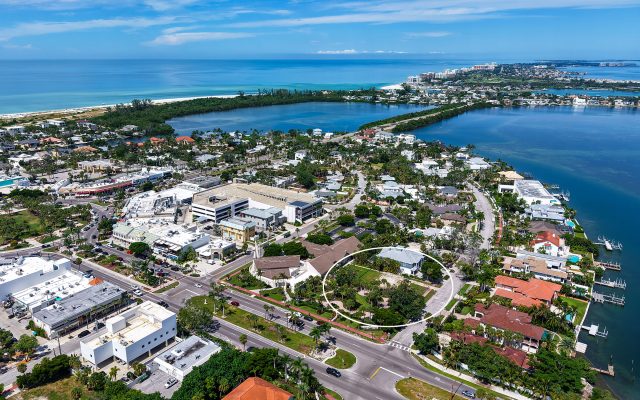
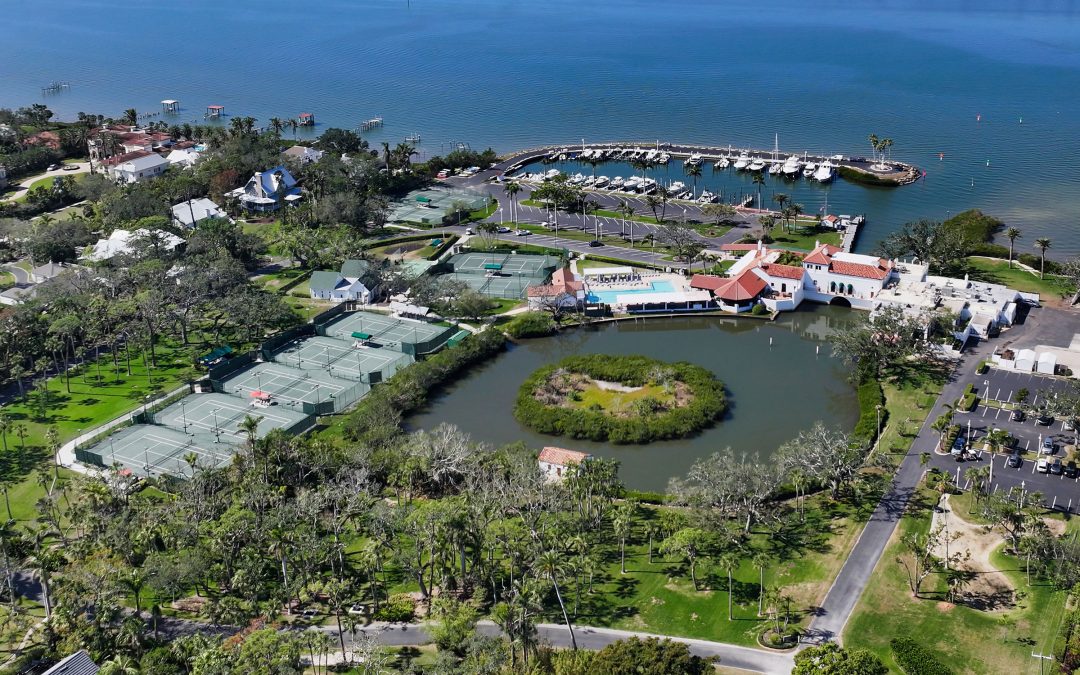
Tucked along the eastern shoreline of Roberts Bay in Sarasota’s coveted West of Trail corridor, The Field Club is one of the community’s most storied private clubs. For many residents of Oyster Bay Estates and the surrounding neighborhoods, it’s a quiet anchor of daily life; a place for boating, tennis, swimming and social gatherings framed by historic architecture and pedigree.
From Great House to Gulf Coast Landmark
Long before it became a private club, The Field Club began as the winter home of Stanley and Sara Carroll Brown Field, part of the Chicago family behind Marshall Field & Company. Drawn to Florida’s “gold coast” in the 1920s, the Fields commissioned renowned architect David Adler to design a substantial yet refined “great house” on what was then a 16-acre estate off Field Road.
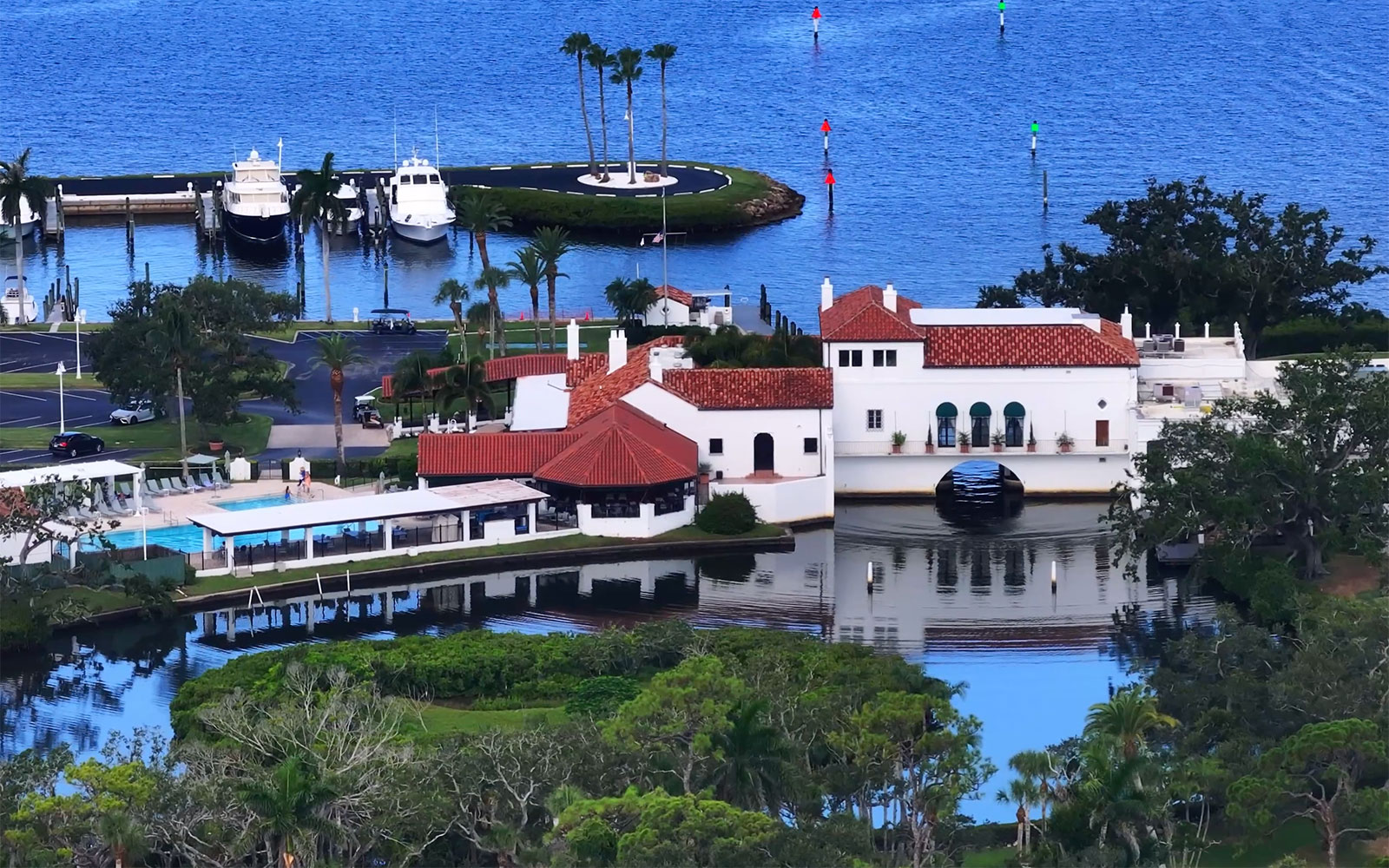
Construction began in 1925 and was completed in 1927. Adler chose an 18th-century Spanish villa style, with white stucco walls, red tile roofs, and a composition that carefully responded to the shoreline and subtropical light. One of the estate’s most distinctive features was a canal that ran beneath the main block of the house, creating the sense that architecture, water and landscape were woven together. A lagoon, formal entry sequence, and a two-story Mediterranean gatehouse completed the picture of a true “great house” retreat on Little Sarasota Bay.
For three decades, from 1927 through the mid-1950s, the Fields wintered in Sarasota, returning each season to what was then a quiet stretch of bayfront.

Saved From Subdivision
By 1957, both Stanley and Sara Field were in their eighties and made the decision to remain in Illinois year-round. As Sarasota’s growth accelerated, there was every likelihood the estate would be subdivided and the house demolished once it changed hands. To help preserve the property, Field authorized a local broker to offer it at the favorable price of $175,000 to any club willing to maintain it for club use rather than redevelopment.
A group of Sarasota Yacht Club members stepped forward, organizing a new club, drafting a charter, and appointing a 15-member board of directors. They chose the name “The Field Club” in honor of the original owners, and the sale closed on July 16, 1957. Architects Ralph and William Zimmerman were engaged to adapt the residence for club life. The front entry was reworked into a service approach, new kitchen facilities were added, and rooms were reconfigured for dining and social spaces. Outside, tennis courts, a swimming pool and expanded yacht docks were introduced, all while preserving the essential character of Adler’s design.
The main building’s exterior remains largely unchanged today and was added to the National Register of Historic Places in 1986, cementing its place as a piece of Sarasota’s architectural and social history.
Life at The Field Club Today
Today, The Field Club is a private, invitation-only tennis, yacht and social club occupying roughly 11 acres of manicured bayfront just south of downtown Sarasota.
From the water, the club is reached via the Intracoastal Waterway at marker 78 on Roberts Bay. A full-service marina provides dockage for members’ vessels, with complimentary first-night dockage and additional nights available for a per-foot daily rate. The club is a member of the Florida Council of Yacht Clubs, giving Field Club boaters reciprocity at fellow FCYC clubs around the state.
On land, the amenities are comprehensive yet contained. A formal dining room, a casual grill and bar, an outdoor terrace, and poolside dining offer different ways to enjoy the club.
Multiple tennis courts, a wellness center, and a pool support an active lifestyle, with adult clinics and year-round tennis programming overseen by the club’s tennis professionals.
Families often describe The Field Club as a multigenerational place. Seasonal youth programs, including sports camps for members’ children and grandchildren, introduce the next generation to tennis, swimming and waterfront fun in a private setting.
Public filings and historical accounts describe membership as intentionally limited, with a cap historically in the range of 550–600 full or family memberships, helping maintain a residential, low-density feel even during peak season.

Membership: What to Know
The Field Club is a private club. Its membership information is not marketed publicly, and most details are handled directly between the club and prospective members. Public filings and historical accounts describe membership as limited, with a cap in the range of 550–600 full or family memberships, helping maintain a residential, low-density feel even during peak season.
Membership is by invitation only. Interested individuals are asked to connect with the club’s Member Relations Director for current information about availability and the application process.
Guest access is limited. Guests must be accompanied by a member, register before using facilities such as the tennis courts, and are limited to a set number of visits per month, underscoring that the club primarily serves its member families rather than operating as a public venue.
Capacity is tightly managed. Outside sources describe membership as capped at under roughly 600 families or full members, a figure consistent with the club’s historic cap of 550 and more recent data indicating a maximum of about 600 full members.
Specific categories (resident, non-resident, junior), initiation fees and dues are not published online. Anyone seriously considering membership should contact the club itself as the definitive resource and request up-to-date information directly from The Field Club’s membership office.
A Quiet Anchor for West of Trail Living
For nearby neighborhoods such as Oyster Bay Estates, Cherokee Park and the surrounding West of Trail streets, The Field Club is more than a pretty backdrop, it’s part of the rhythm of life. Residents walk or bike past the Mediterranean gatehouse, watch sails come and go on Roberts Bay, and often gather at the club for dinners, children’s activities and waterfront events.
From a real estate perspective, its presence adds a layer of history that’s difficult to replicate: a historic David Adler estate, preserved and adapted for contemporary club life, with a full marina and recreational offerings right in the heart of Sarasota’s coastal residential district.
For buyers considering a home near The Field Club, whether in Oyster Bay Estates, Granada, or other nearby West of Trail communities, understanding the club’s story is part of understanding the neighborhood. This is a corner of Sarasota where architecture, water and community have been intertwined for nearly a century, and where the legacy of a 1920s “great house” shapes the way people live on the bay today.