
Blue State Taxes Cost More Than You Think
For high-income households considering a move to Florida, the financial difference can be much larger than simply eliminating a state income-tax bill. In a recent Wall Street Journal column, economist Stephen Moore posed a provocative question: Would you move for what amounts to a 30% increase in take-home pay? For some high earners moving from California or New York City to Florida, his calculations suggest the answer could be yes.
The Math Behind the 30%
Consider a married couple earning $5 million annually.
California’s top individual state income-tax rate reaches 13.3%. New York State’s top rate is 10.9%, while New York City adds a top local income-tax rate of 3.876%. Florida, by comparison, imposes no individual state income tax.
Moore’s Wall Street Journal example combines the highest state and local rates with federal taxes and estimates that a very high-income household in California or New York City could retain roughly 46 cents of each additional dollar earned, compared with approximately 60 cents in a state without an individual income tax. That difference is where the eye-opening number comes from: 60 cents is approximately 30% more than 46 cents. It isn’t literally a 30% increase in salary. It is an illustration of how dramatically the amount of income retained after taxes can change based solely on where a taxpayer lives.
And unlike a one-time bonus, the potential difference repeats year after year.
When Location Becomes a Wealth Decision
For someone at a high income level, state residency can therefore become an important part of long-term financial planning. According to Moore’s analysis, the estimated reduction in after-tax income for a high-income household living in certain higher-tax jurisdictions rather than a no-income-tax state can be substantial:
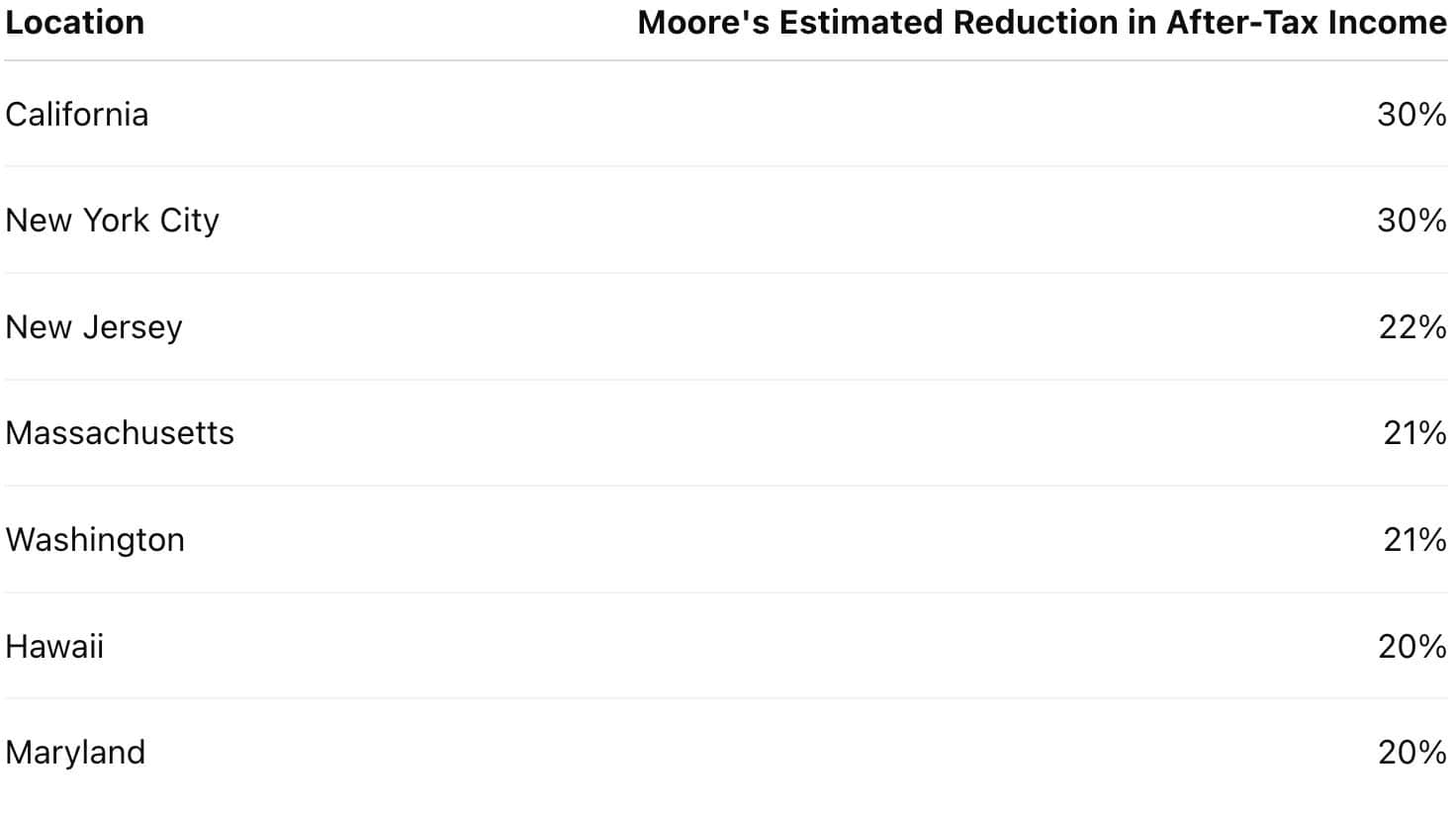
These are illustrative calculations for high-income taxpayers rather than universal savings applicable to every household. Income sources, deductions, capital gains, property ownership, business interests and residency rules can all change the equation.
Still, the underlying difference is significant. Florida currently has no individual income tax and also does not impose an estate or inheritance tax.
Americans Are Already Voting With Their Feet
The tax discussion is occurring against a much larger backdrop of interstate migration. The IRS has tracked state-to-state migration through changes in addresses reported on individual tax returns for decades. Importantly, its data measure not only the movement of taxpayers, but also the adjusted gross income associated with those taxpayers.
Florida has been one of the country’s major beneficiaries of domestic migration during much of the past decade, although the pace moderated considerably in the most recent Census estimates. That is an important distinction: taxes are one consideration among many, and migration patterns change with housing costs, employment, retirement, family circumstances and broader economic conditions.

For affluent households, however, the growing ability to manage businesses, investments and professional responsibilities from different locations has made the question of residency increasingly relevant.
Why Sarasota Enters the Conversation
For those who already have the flexibility to choose where they live, Florida’s tax structure can change the economics of that decision.
Then comes the more personal question: Where in Florida do you want to live?
For many of our clients, Sarasota offers an appealing answer. Waterfront neighborhoods, downtown condominium residences, established West of Trail enclaves, golf and country club communities, and properties with greater land and privacy provide distinctly different ways to make Sarasota home. In addition, Sarasota’s growing business community is attracting executives to Florida.
The financial advantages of Florida may start the conversation. The quality of life in Sarasota can make the decision considerably easier. For someone contemplating a transition from New York, California, New Jersey, Massachusetts or another higher-tax state, that can make real estate more than a housing decision. It can become one component of a larger strategy for how and where you want to live, preserve wealth and spend the years ahead.
Whenever the time is right, the Laughlin Tanner Group can provide perspective on Sarasota luxury real estate and help identify the neighborhoods and properties that best fit the way you want to live in Florida.
Tax circumstances vary significantly by individual, and establishing Florida residency involves requirements beyond owning a home in the state. Consult your tax, legal and financial advisors regarding your individual circumstances.